


Sodium hydroxide
Sodium hydroxide , or caustic soda (NaOH), is a basic chemical. It is a properties of strong alkalinity, high corrosiveness, excellent moisture absorption, and a violent exothermic reaction when dissolved in water. Caustic soda has a wide range of applications in manufacturing and industrial. Including pH adjustment in wastewater treatment systems, pulp and paper production (Kraft process), food and cosmetic manufacturing, aluminum extraction (Bayer process), and as an intermediate in the production of other chemicals.
Sodium hydroxide is generally use in 3 main forms:
Caustic soda flakes 98% : This is the most popular form, easy to transport, and has a high concentration of up to 98%. It’s suitable for dyeing, bleaching, and cleaning machinery.
Caustic soda pearls : These are small, spherical granules. Their advantage is less dust than flakes and they dissolve very quickly in water. They are often use in industries requiring high precision, such as soap and cosmetics production.
Caustic soda liquid : Available in various concentrations such as 20%, 25%, 32%, and 50%. For large industrial plants with chemical storage and dispensing systems, using caustic soda liquid reduces the need for chemical dissolution and minimizes the risk of direct chemical exposure for employees.
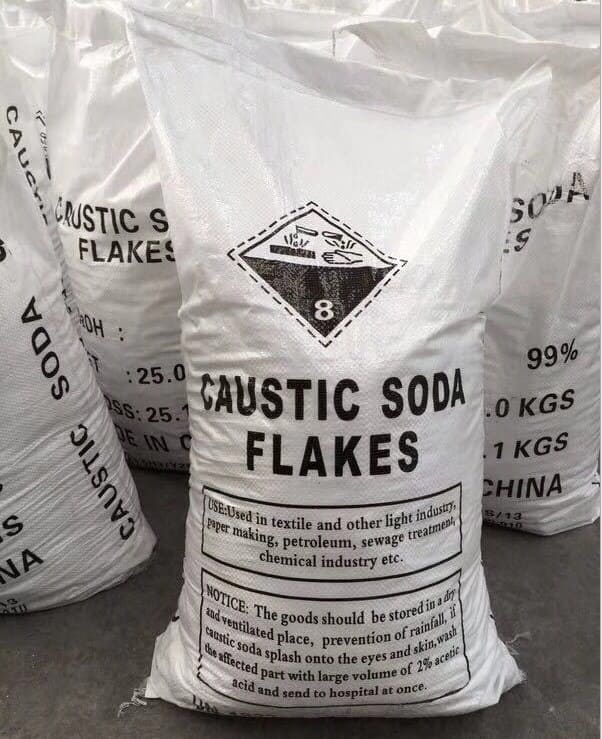
Properties of Sodium hydroxide:
- Molecular Formula: NaOH
- Purity (flakes/pearls): 98% – 99%
- Concentration (water): 20%, 25%, 32%, 50%
- Melting/Freezing Point: 9-12 °C
- Boiling Point: 143 °C (for a 50% concentration solution)
- pH: 13 – 14
- Relative Density (water = 1): 1.5 at 15 °C
- Vacuum Pressure: 13 mmHg (0.2 kPa) at 20 °C
Furthermore, caustic soda in its solid state (flakes or pearls) has a strong hygroscopic property. If left in normal atmospheric conditions, it will absorb water vapor and carbon dioxide (CO2). Then becoming a solution through a phenomenon known as deliquescence. Therefore, it must be stored in a tightly sealed and completely dry container.
Benefits of Sodium hydroxide:
The pulp and paper industry use caustic soda in the Kraft Process to separate lignin from wood cellulose fibers. Resulting in white and strong paper pulp. It’s also used in bleaching pulp and in wastewater treatment at paper mills.
The aluminum production industry: In metallurgy, caustic soda is crucial in the Bayer Process, a step in extracting alumina from aluminum ore.
The chemical manufacturing industry use sodium hydroxide as an intermediate in the production of many other chemicals. Such as PVC plastics, sodium hypochlorite, and epoxy resin.
The food and beverage industry use food-grade caustic soda in various processes. Such as bottle washing for sterilization and cleaning of reusable glass bottles, food processing, and softening certain foods.
The petroleum and refining industry use caustic soda in oil refineries. In a process called “caustic washing” to remove acidic impurities such as hydrogen sulfide and various organic acids from crude oil and natural gas, resulting in cleaner oil and reduced corrosion in pipelines.
In the renewable energy industry (biofuels), in the production of biodiesel use caustic soda as a catalyst in the transesterification reaction that converts vegetable oils or animal fats into fuel.

Looking to purchase Sodium hydroxide for industrial use?
Thai Engineering Gas Co., Ltd. (TEG) is a distributor of sodium hydroxide (caustic soda) in 98% granular form size 25 kg bags, and in liquid form with various concentrations from 20% to 50%. We provide bulk delivery using chemical tank trucks (10-16 tons) for pumping into customer storage tanks, ensuring safety, convenience, and precise quantities to meet customer needs.