


Cautions regarding ammonia-based refrigeration systems.
Cautions regarding ammonia-based refrigeration systems.
As summer approaches, Admin TEG would like to share a helpful article about “Precautions for Ammonia-Refrigerated Refrigeration Systems.” This is because most ice factories and cold storage facilities will likely be ramping up production to meet increased demand. However, even with increased production, safety should always be prioritized.
Statistics compiled by Admin TEG from 2017 to 2020 show that there have been numerous ammonia gas leaks each year, resulting in loss of life and property. The main cause is a lack of proper and continuous maintenance. This article will discuss basic guidelines for checking ammonia-refrigerated refrigeration systems.
Guidelines for basic checking of ammonia-based refrigeration systems.
1. The refrigeration system and control equipment must be in perfect and safe working condition, such as being free from corrosion and leaks. Safety checks must be conducted at least once a year by a qualified engineer, and a continuous maintenance plan must be in place.
2. Pressure vessels in the refrigeration system, such as receiver tanks, oil separators, shell and tube heat exchangers, intercooler tanks, ammonia accumulator tanks, and tube ice towers, must be constructed robustly and correctly according to engineering principles.
3. The refrigeration system must have the following complete components:
- All compressors must be equipped with:
- Suction stop valve
- Discharge stop valve
- Discharge check valve
- Low pressure cutout switch
- High pressure cutout switch
- If the compressor uses an oil pump, a low oil pressure cutout switch must be installed
- Pressure gauges for the suction, discharge, and compressor oil pump pressures.
- If the ammonia piping system is equipped with end-and-end shut-off valves, a pressure relief device must be installed in the shut-off section to prevent pipe rupture due to liquid ammonia expansion.
- Ammonia pumps (refrigerant pumps) must be equipped with suction and discharge shut-off valves.
- Liquid level monitoring devices – End-and-end shut-off valves with integrated check valves must be installed to reduce the danger in case of glass tube breakage, and a strong, impact-resistant baffle must surround the glass tube along its entire length.
- Ventilation of the ammonia machinery room – Must be well-ventilated. If enclosed, adequate ventilation fans must be installed.
- Pressure relief device
- Single or double safety valves, or other suitable pressure relief devices, must be installed on all pressure vessels, heat exchangers, oil separators, oil transfer tanks, and at various points in the refrigeration system where necessary to prevent rupture from overpressure. A drain pipe must be connected to water with sufficient volume to absorb ammonia (8.344 liters of water per 1 kilogram of ammonia)
- All pressure relief valves must be set with an opening pressure not exceeding the design pressure of the system or equipment.
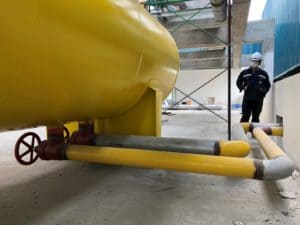
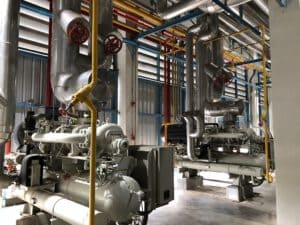
4. General requirements
- A qualified and experienced refrigeration system operator must be assigned to control and repair the refrigeration system in case of ammonia leaks.
- The main shut-off valves in the system, including the liquid ammonia main valve, the hot gas main shut-off valve for defrosting, the main liquid refrigerant shut-off valve from the ammonia pump, and the ammonia pump shut-off valve, must be easily accessible and clearly labeled for convenient shut-off in case of ammonia leaks.
- If there is only one outlet from the machine room to other operating areas, ammonia piping or system equipment must not be routed through that passageway, and there must be no obstructions.
- The oil drain valve must be a loaded valve.
- Ammonia gas detectors must be installed in the machine room and the workers’ area, at least one unit per room.
- In the case of a swollen and ruptured freezer tube in an ice tower.
- Cause
- Using seamed pipes that do not meet standards.
- Ice crystals remained inside the freezer tube and were repeatedly cooled, causing them to expand and push the freezer tube until it swelled and burst.
- Suggestions for accident prevention
- Using seamed pipes that do not meet standards.
- Pay close attention to the defrosting process after each cycle. Regularly observe the ice cubes to see if they are white, have clogged holes, or are dispensing slowly. Check the amount of ice being dispensed in each cycle. If you find that not enough ice is being dispensed, repeat the defrosting process or extend the defrosting time. This is especially important during cold weather, as incomplete ice dispensing is a common problem.
- In the event of an ammonia accumulator tank explosion.
- Cause
- The design, calculations, and certification were not properly performed according to engineering principles, and the materials used in its construction were unsuitable.
- The welding process was not in accordance with engineering principles.
- The repair of the weld leak was not done according to engineering principles.
- Suggestions for accident prevention.
- The installation of ammonia-based refrigeration systems and the construction of pressure vessels within these systems require proper engineering design, calculations, and construction control, with certification from an engineer.
- Repairing equipment, especially pressure-sensitive components, must be carried out correctly according to engineering principles under the supervision of an engineer.
Source: Factory Safety Technology Promotion Division, Department of Industrial Works.