Trends in reducing HFC refrigerant usage in Thailand (HFCs Phase-down)
Currently, almost all manufacturers of air conditioners and refrigerators, as well as installers of refrigeration and air conditioning (HVAC) systems, have switched to using HFCs (Hydrofluorocarbon) refrigerants such as R32, R410A, R404A, and R134a to replace HCFCs (Hydrochlorofluorocarbon) refrigerants like R22, which will eventually be banned from import (see more information in…). “Trends in Reducing HCFC Refrigerant Use in Thailand (HCFCs Phase-Out)”
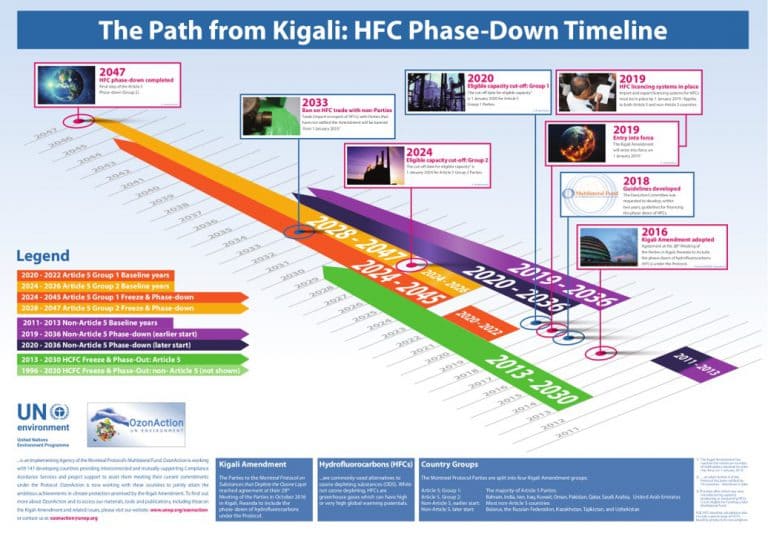
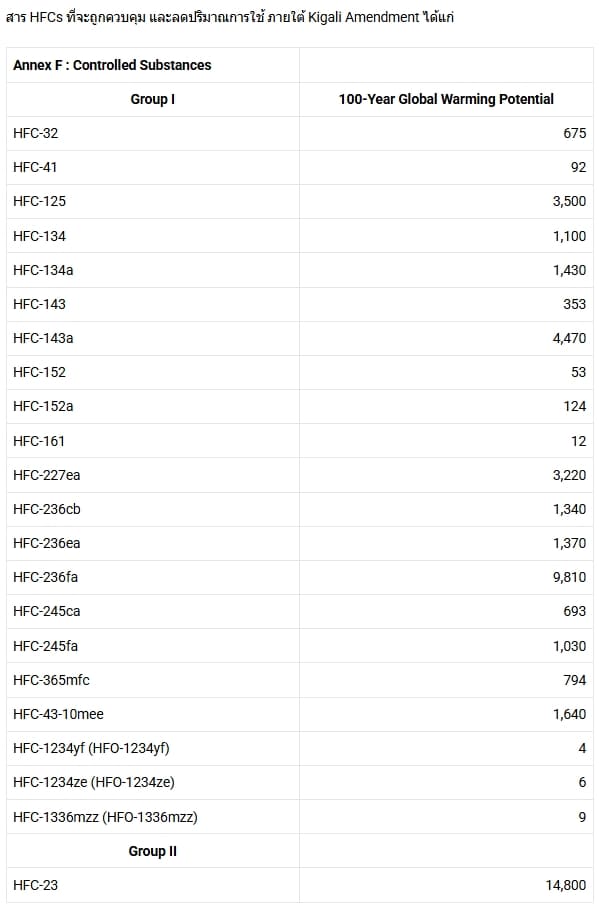
However, these HFC refrigerants still have high global warming potential (GWP) and ozone-depleting potential (ODP). Therefore, at the most recent meeting of the Parties to the Montreal Protocol, held on October 28, 2016, in Kigali, an agreement was reached (known as the Kigali Amendment) to reduce the use and production of HFC refrigerants by 85%, leaving only 15% of current usage. The plan for reducing refrigerant use is as follows:
Developed countries are subdivided into two groups:
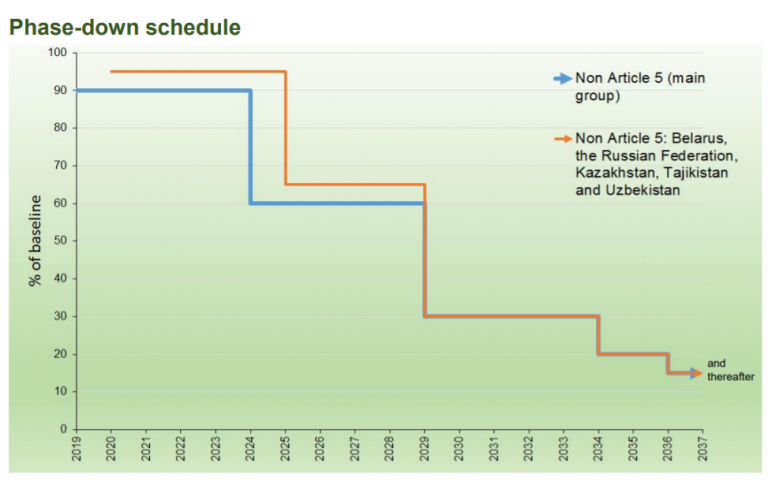
Group 1: Almost all developed countries began controlling emissions in 2019, with a target of reducing it to 15% by 2036.
Group 2: Belarus, the Russian Federation, Kazakhstan, Tajikistan, and Uzbekistan began controlling emissions in 2020, with a target of reducing it to 15% by 2036.
Developing countries are subdivided into two groups:
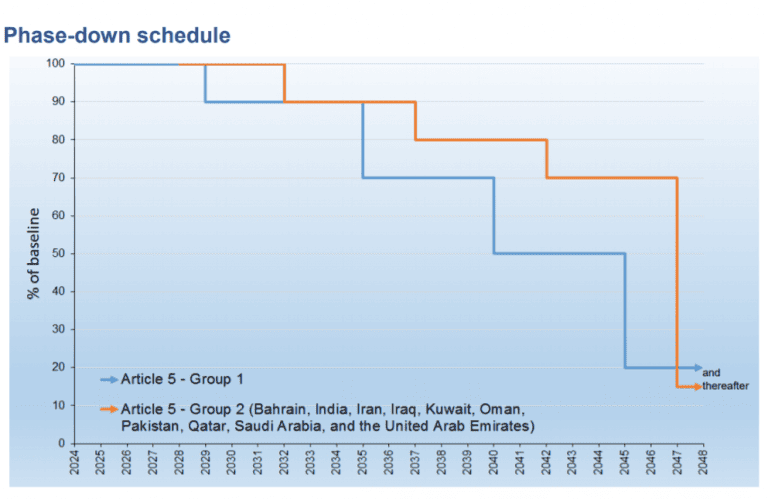
Group 1: Almost all developing countries, including Thailand, will begin controlling emissions in 2024 (or in 5 years) and aim to reduce it to 20% by 2045.
Group 2: Bahrain, India, Iran, Iraq, Kuwait, Oman, Pakistan, Qatar, Saudi Arabia, and the UAE will begin controlling emissions in 2028 and aim to reduce it to 15% by 2047.
Alternative Refrigerants
If Thailand implements import controls according to the set timeframe and targets, the next question is: what refrigerants will replace HFCs? Or what type of refrigerants will they be? In fact, manufacturers, government agencies, and the private sector have been aware of these issues for a long time and have begun experimenting with or using alternative refrigerants such as ammonia (NH3) or R717, carbon dioxide (CO2), and natural or environmentally friendly refrigerants such as R290 (or propane), R600a (or isobutane), and R1270 (or propylene). These refrigerants are classified as hydrocarbons (HCs) and are already being used in the refrigerator, freezer, and air conditioning industries, with a tendency for their use to increase.
In the next section, we will discuss natural or environmentally friendly refrigerants, their properties, applications, advantages, and disadvantages. For consideration of future use.
Reference
- UNEP OzonAction Fact Sheet: The Kigali Amendment to the Montreal Protocol: HFC Phase-down
- www.unenvironment.org